




























Blog
How to start trading shares on NEPSE
Opening a broker account, funding it, placing your first buy order on TMS, T+2 settlement and how selling works — a practical guide for new NEPSE traders.
Buying shares in the secondary market is the next step after IPOs — and it gives you access to every company listed on the Nepal Stock Exchange (NEPSE). Here is the full path from opening your accounts to settling your first trade.
Step 1 — Get your demat account
All NEPSE shares settle electronically, so a demat account under CDSC is mandatory. As a Depository Participant we can open one for you the same day you complete KYC.
Step 2 — Open a broker (TMS) account
To trade you need an account with a licensed broker. Complete our KYC form with your citizenship certificate, photo, bank details and demat number — online or at our office. Once verified, you receive credentials for the TMS (Trading Management System), the web platform where orders are placed.
Step 3 — Fund your account
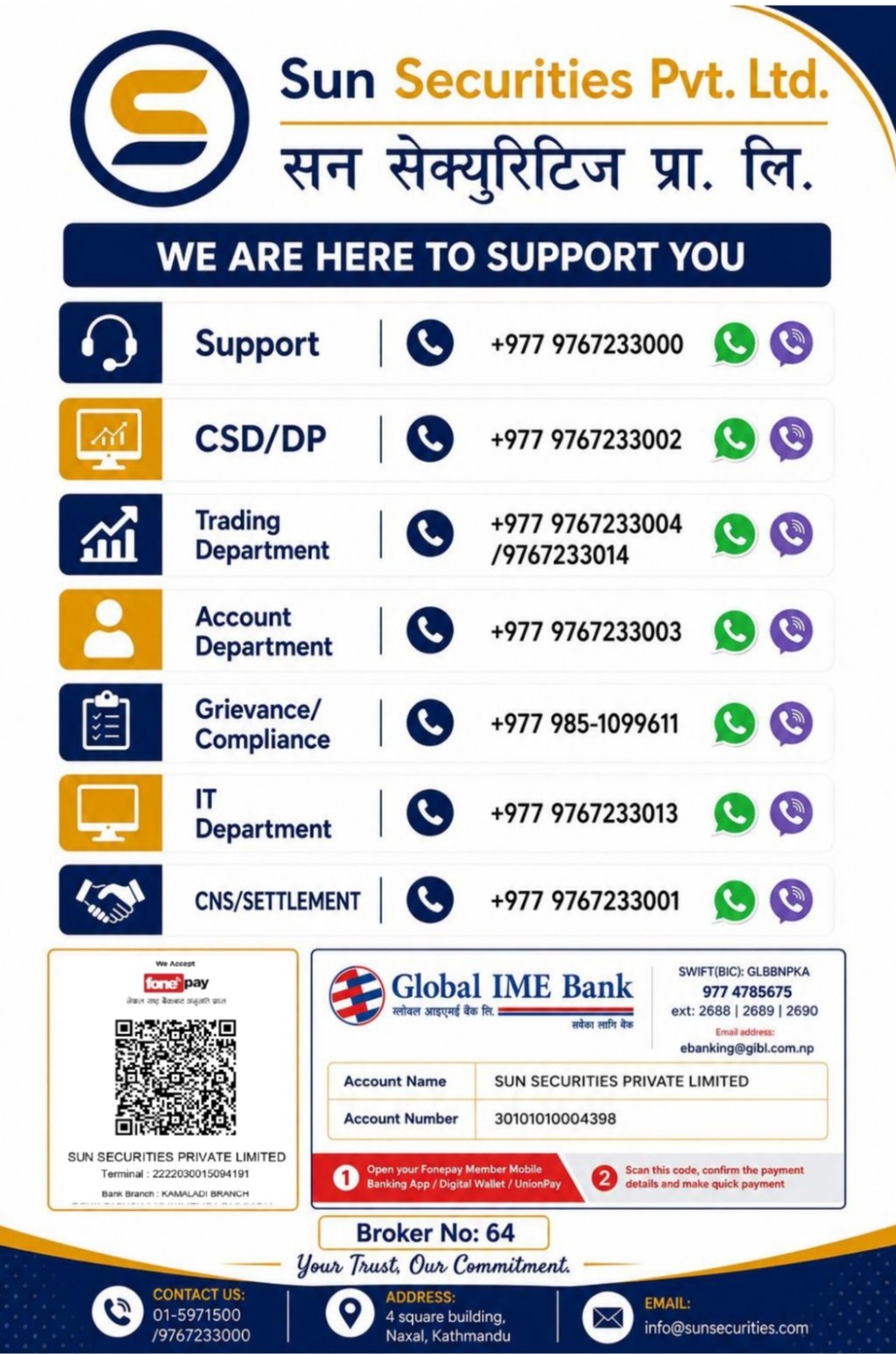
Before buying, deposit funds to our settlement bank account (or maintain collateral as agreed) and share the voucher with our desk. Your TMS buying power updates once the deposit is confirmed.
Step 4 — Place your first buy order
- Log in to TMS during market hours — NEPSE trades Sunday to Thursday, 11:00 AM to 3:00 PM.
- Search the stock symbol and check the LTP (last traded price) and market depth.
- Place a limit order: choose quantity and the exact price you are willing to pay.
- Wait for the order to match — you can modify or cancel unmatched orders any time.
Note that each stock can move only within a fixed daily price band (about 10% either side of the previous close), and index-level circuit breakers pause the whole market after sharp moves.
Step 5 — Settlement (T+2)
NEPSE settles trades on a T+2 cycle: two trading days after your buy matches, the shares arrive in your demat account and your payment to the broker falls due. Pay by the settlement deadline to avoid penalties — a simple bank transfer with the trade bill reference is enough.
How selling works
Selling is the same flow in reverse, with two extras. First, your capital gains tax is calculated against the WACC (weighted average cost) of your holdings — 7.5% for individuals holding under a year, 5% over a year. Second, after your sell order matches you must transfer the shares to the buyer through EDIS in MeroShare (the My EDIS section) before the settlement deadline. Sale proceeds, minus commission and taxes, are then transferred to your bank account.
What does trading cost?
Broker commission is fixed by the regulator on a sliding scale by trade size, plus the SEBON fee and the Rs 25 DP charge per scrip per settlement day. The complete schedule — and an interactive calculator — is on our Fees & Commission page.
Before you start
- Start small and learn how order matching behaves before committing serious capital.
- Use limit orders — market swings inside the daily band can be sharp.
- Keep records of every trade bill for tax purposes.
New to all of this? Our free investor education videos cover each step, or talk to our trading desk during market hours.